Software
Local Pathogen Analysis Platform
Analyze Oxford Nanopore sequencing data for bacteria, viruses, and mixed samples. Free, easy to use, and fully offline after setup.

Version 1.0.0 · Free and open source · macOS 13 or later (Apple Silicon) or Ubuntu 24.04
Pathogen analysis, made simple.
Analyzing sequencing data shouldn't require complicated software, powerful servers, or years of bioinformatics experience.
LPAP brings everything together in one easy-to-use desktop application. Import your Oxford Nanopore sequencing data, choose an analysis, and explore your results in an interactive report.
From identifying pathogens to detecting antimicrobial resistance and virulence genes, LPAP handles the technical work so you can focus on the findings.
And because everything runs locally, you can use LPAP wherever you bring your laptop - whether that's a research laboratory, a hospital, or a remote field station.

The LPAP desktop application in the field.
Three analysis workflows. One application.
LPAP brings together three types of pathogen analysis, each designed to turn raw sequencing data into meaningful results.
Bacterial analysis
Identify bacterial species and investigate their genetic characteristics, including antimicrobial resistance genes, virulence factors, plasmids, and sequence types (MLST).
Viral analysis
Identify viruses in sequencing data and generate consensus genome sequences for further investigation.
Metagenomic analysis
Explore complex samples containing many different organisms. Identify bacteria, viruses, and other microorganisms, detect potentially relevant pathogens, and investigate antimicrobial resistance and virulence genes.
All three workflows include sequencing quality control, pathogen watchlist screening, and interactive reports.
From sequencing data to results in three steps.
1. Import your data
Add your Oxford Nanopore FASTQ files directly to LPAP.
2. Choose your analysis
Select bacterial, viral, or metagenomic analysis. LPAP automatically handles quality control and runs the appropriate bioinformatics tools using locally installed reference databases.
3. Explore and share your results
View your findings in an interactive dashboard, or export standalone HTML reports that can be opened in any modern web browser and shared with collaborators.
No command-line required.
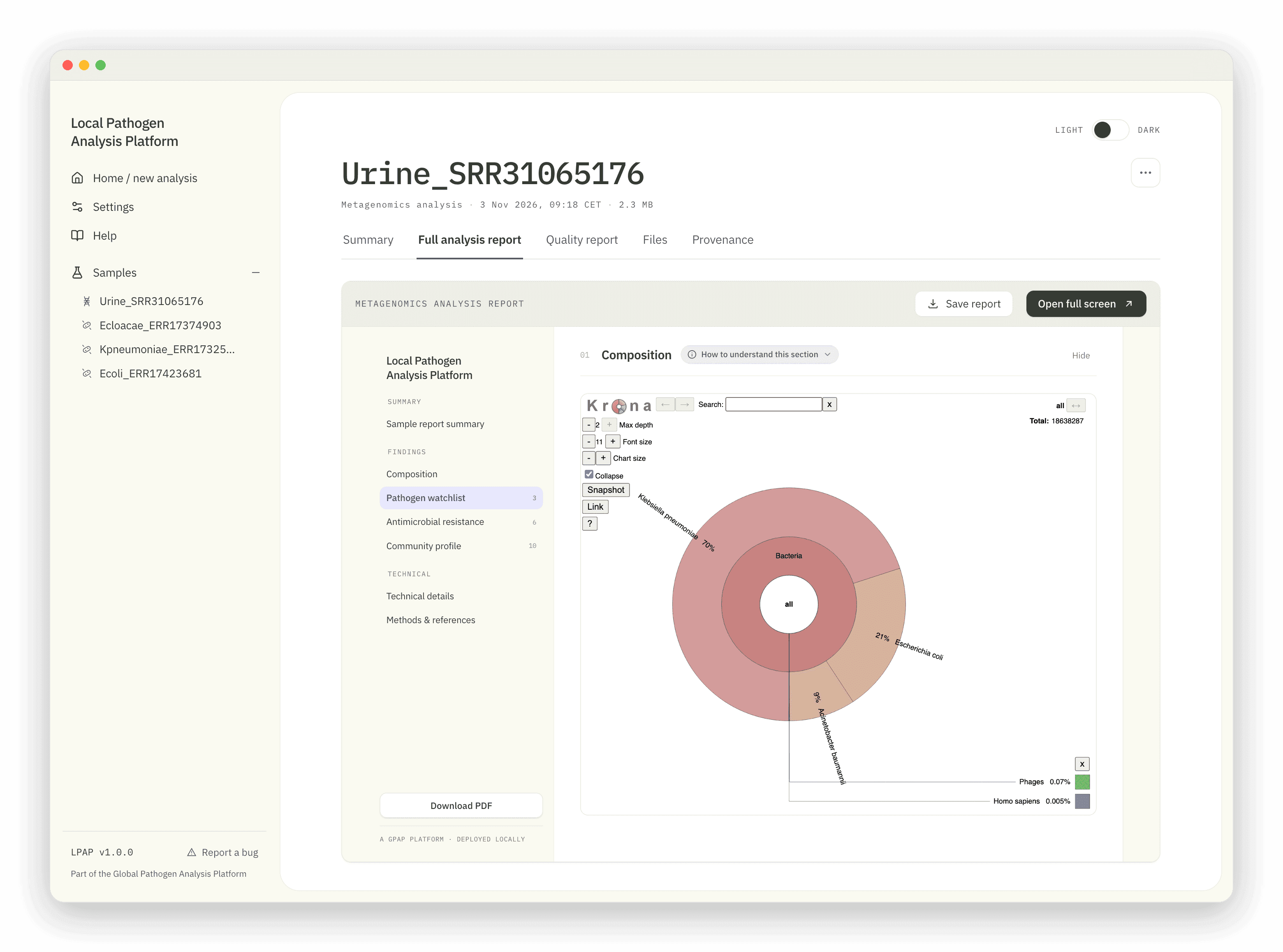
An interactive metagenomic analysis report in LPAP, showing the organisms detected in a sample. Explore microbial composition, pathogen watchlist findings, and antimicrobial resistance results. Reports can be saved and shared with collaborators.
Built for laboratories everywhere.
Works offline
Once installed, LPAP can run all its analyses without an internet connection. The tools and reference databases are stored on your computer, making it suitable for laboratories and field locations with limited connectivity.
Everything in one place
No need to install and configure separate bioinformatics pipelines. LPAP brings the analysis tools, databases, and reporting together in a single application.
Your data stays with you
Analyses are performed locally, without uploading your sequencing data to an external server or cloud service.
Clear, shareable reports
Every analysis produces interactive HTML reports covering read quality and analysis results. Reports can be opened and shared independently of LPAP.
Optional AI-assisted interpretation
LPAP can use a locally running AI model to help explain analysis findings in plain language. No external AI service is required. AI-generated interpretations should always be reviewed alongside the full results.
System requirements
LPAP is available for macOS and Linux, with Windows support is currently in development.
- macOS: macOS 13 or later, Apple Silicon.
- Linux: 64-bit Linux, tested on Ubuntu 24.04.
- Memory: Approximately 16 GB RAM for the smaller reference database option, or 32 GB for the larger option.
- Input data: Oxford Nanopore FASTQ files.
- Storage: Substantial free disk space is required for the reference databases.
- Internet: Required for standard initial setup and updates. Reference databases can also be installed from local media.
LPAP is intended for pathogen research, investigation, and surveillance. It has not been validated for clinical diagnosis.