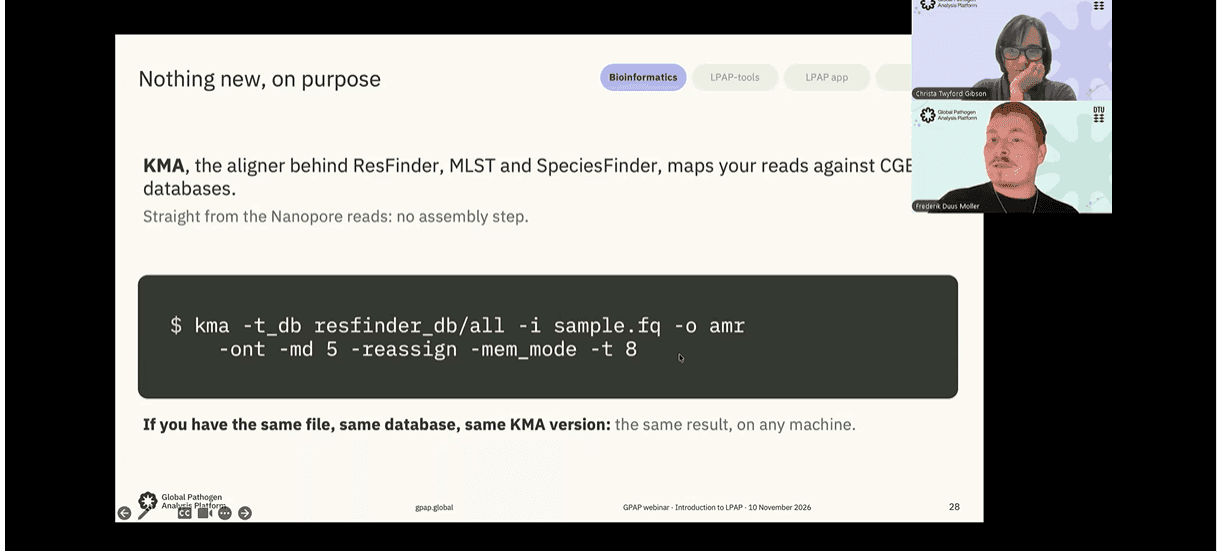
The GPAP community came together on 10 November for the first in a new series of technical webinars, offering participants an early look at LPAP, the Local Pathogen Analysis Platform. During the webinar DTU bioinformatician Frederik Duus Møller introduced the thinking behind LPAP, demonstrated the tool in action, and provided an opportunity for participants to ask questions and help shape its continued development.
The timing of the webinar was particularly exciting: the first public version of LPAP, Version 1.0, is expected to be ready for release in the next month. You can watch a recording of the webinar here.
Bringing pathogen analysis to the laptop
LPAP is being developed as the local, laptop-based complement to GPAP. While the full GPAP platform will enable online analysis, sharing, comparison and collaboration, LPAP is designed for situations where users want or need to analyse genomic data locally. Once installed, it can operate offline.
This is particularly important in settings where internet connectivity may be limited, or where data cannot easily be uploaded. The aim of LPAP, like GPAP, is to make trusted pathogen genomic analysis more accessible without requiring users to manage multiple command-line tools or rely on specialised bioinformatics expertise for every step.
Møller shared, “The idea behind LPAP is to bring the analysis closer to where the samples are actually taken. We want users to be able to go from raw sequence data to results on their own laptop, without needing to send their data somewhere else or navigate a series of specialised bioinformatics tools.”
During a live demonstration, participants saw how users can add raw sequence data and let LPAP take care of the underlying analytical steps. Participants in the webinar had the opportunity to ask questions, which will inform the further development of the tool. “LPAP is still developing, and that means users can help shape where it goes next. The more we understand about the data people are working with and what they need from the tool, the better we can make it work for them,” said Møller.
The tool currently includes pipelines for bacterial isolates, viruses and metagenomic samples, together with quality control and screening against a pathogen watchlist. Results are brought together in interactive reports that can be searched, filtered and shared. The reports provide access to both the results and the technical details behind them, including the versions of tools and databases used, supporting transparency and reproducibility. An optional locally running AI model can also provide a plain-language interpretation of key findings, while the full underlying results remain available for users to review and verify.
Version 1.0 coming soon
The upcoming release marks an important milestone for LPAP. Version 1.0 will package the application and its dependencies into a tested bundle, with installation designed to work much like installing a standard desktop application. At launch, the tool will support Mac and Linux and Oxford Nanopore data, with additional functionality planned for subsequent versions.
More Webinars Coming Up
This webinar was just the beginning. GPAP plans to continue holding technical webinars approximately every three months, alongside more practical learning opportunities and workshops as the platform develops.
Keep an eye on the GPAP newsletter for the announcement of LPAP Version 1.0 and information on how to download and start exploring the tool.